18.39°C Vancouver

Apr 19, 2021 9:29 PM -

Federal Budget 2021: Highlights from Chrystia Freeland's speech and reaction

Share On
federal-budget-2021-highlights-from-chrystia-freelands-speech-and-reaction
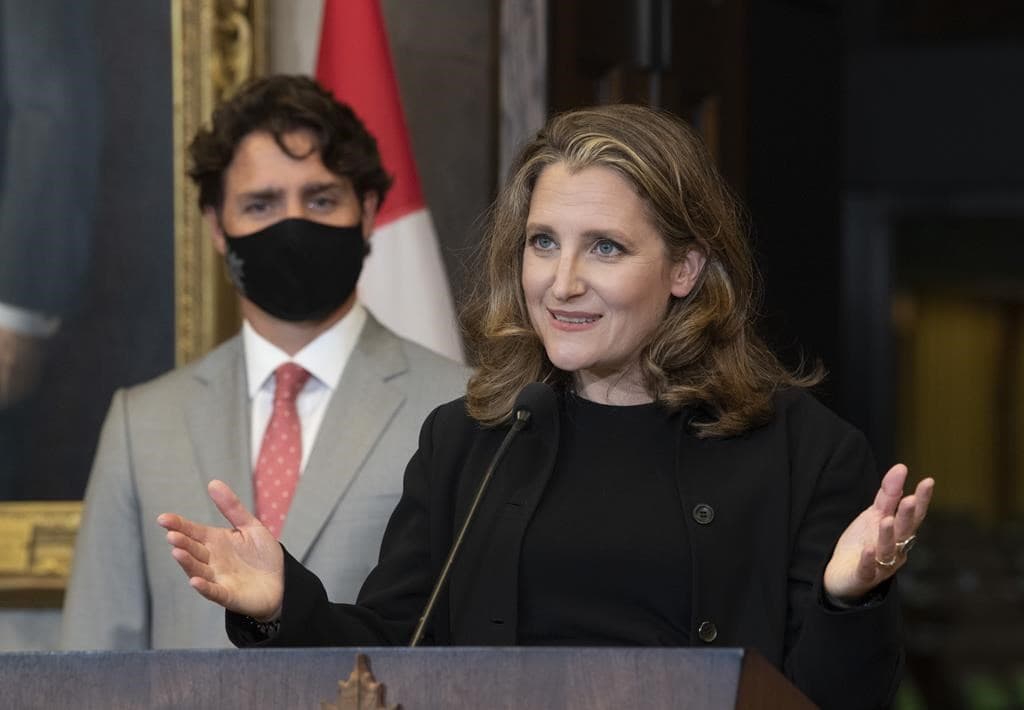
Prime Minister Justin Trudeau looks on as Deputy Prime Minister and Finance Minister Chrystia Freeland responds to a question during a news conference on Parliament Hill in Ottawa, Tuesday, Aug. 18, 2020. THE CANADIAN PRESS/Adrian Wyld

Highlights from the federal Liberal budget tabled Monday by Finance Minister Chrystia Freeland:

$30 billion over the next five years, and $8.3 billion ongoing for early learning and child care and Indigenous early learning and child care.

The plan would aim to see an average drop in fees next year by 50 per cent for preschooler daycare spaces and an average of $10-a-day care by 2026.

$3 billion over five years, starting in 2022-23, to Health Canada to support provinces and territories in improving standards for long-term care. The government says this funding will keep seniors safe and improve their quality of life.

$2.2 billion in Canada's bio-manufacturing and life-sciences sector to rebuild Canada's national capacity in bio-manufacturing and vaccine development and production.

Introducing legislation to establish a federal minimum wage of $15 per hour, rising with inflation, with provisions to ensure that where provincial or territorial minimum wages are higher, that wage will prevail.

A new Canada Recovery Hiring Program to provide eligible employers with a subsidy of up to 50 per cent on the incremental remuneration paid to eligible employees between June 6 and November 20.

The program will provide $595 million to make it easier for businesses to hire back laid-off workers or to bring in new ones.

$17.6 billion towards a green recovery to create jobs, build a clean economy, and fight and protect against climate change.

$1 billion over six years, starting in 2021-22, to the Universal Broadband Fund to support a more rapid rollout of broadband projects in collaboration with provinces and territories and other partners.

$18 billion over the next five years to try to narrow the socio-economic gap between Indigenous and non-Indigenous people, including $6 billion for infrastructure in Indigenous communities, and $2.2 billion to help end the tragedy of missing and murdered Indigenous women and girls.

$2.5 billion and reallocate $1.3 billion in existing funding in order to help build, repair or support 35,000 housing units.

Introduce Canada's first national tax on vacant property owned by non-residents.

Introducing a new tax on the sales, for personal use, of luxury cars and personal aircraft with a retail sales price over $100,000, and boats, for personal use, over $250,000.

Includes $100 million in new spending over the next three years.

Records a $155 billion deficit for 2021-22.
Latest news

rcmp-investigating-five-suspicious-brush-fires-near-shuswap-lake-amid-extreme-wildfire-danger
BCAug 07, 2026

RCMP investigating five suspicious brush fires near Shuswap Lake amid extreme wildfire danger

RCMP are investigating five suspicious brush fires reported in the Shuswap Lake area after multiple fires broke out within a short period Wednesday evening while the region was under an extreme wildfire danger rating. According to the Columbia Shuswap Regional District, three fires were reported along Squilax–Anglemont Road, each approximately 100 metres apart. Shortly afterward, two additional fires were reported in the nearby Anglemont Estates area. Officials said the fires were contained quickly due to the prompt response of local residents and firefighters, preventing significant damage.
CanadaAug 07, 2026

Canada weighs trade concessions as it seeks relief from U.S. tariffs

The federal government is considering a series of trade concessions as it seeks relief from tariffs imposed by the Trump administration, according to sources familiar with the discussions. The measures under consideration reportedly include easing restrictions on the sale of U.S. liquor in some provinces, removing Canada's retaliatory tariffs on automobiles and expanding market access for U.S. dairy products. According to the sources, Prime Minister Mark Carney's government is attempting to demonstrate to the United States that Canada is committed to improving bilateral trade relations. One of
b-c-adds-17-800-net-jobs-in-july-as-unemployment-rate-falls-to-6-2
BCAug 07, 2026

B.C. adds 17,800 net jobs in July as unemployment rate falls to 6.2%

British Columbia added a net 17,800 jobs in July, bringing the province's unemployment rate down to 6.2 per cent, according to employment figures highlighted by B.C. Jobs and Economic Development Minister Ravi Kahlon. Kahlon said the province recorded the largest increase in full-time employment in Canada during the month, with 32,500 full-time jobs added. The increase included 16,200 new full-time positions held by women, according to the provincial government. The minister also said B.C.'s manufacturing sector gained 3,100 jobs in July, while employment in the agriculture sector increased 43
premier-eby-addresses-wildfire-response-confirms-arrival-of-international-firefighting-crews
BCAug 07, 2026

Premier Eby addresses wildfire response, confirms arrival of international firefighting crews

Premier David Eby addressed reporters in Abbotsford on Thursday evening following continued questions about his public absence during British Columbia's ongoing wildfire emergency. During the news conference, Eby issued an update on the province's wildfire response and confirmed the arrival of additional international firefighting personnel. According to the premier, a second contingent of firefighters from Mexico, Australia and New Zealand has arrived in British Columbia to support wildfire suppression efforts. The crews will work alongside personnel from Alberta, Quebec and Yukon to strength
BCAug 07, 2026

B.C. considers cutting development charges to spur housing construction in high-growth communities

The British Columbia government is considering reducing development cost charges to encourage the construction of new homes in the province's fastest-growing communities. Housing Minister Christine Boyle confirmed the province is in discussions with the federal government on a proposal that would reduce development cost charges by up to 50 per cent for multi-unit housing projects in rapidly growing municipalities. According to the minister, the plan also includes exploring options to offset the funding shortfall municipalities would face if the fees are reduced. Development cost charges are pa

Related News