22.78°C Vancouver

Mar 22, 2020 6:03 PM -

Trudeau says Canada is not at the point of declaring a federal emergency

Share On
trudeau-says-canada-is-not-at-the-point-of-declaring-a-federal-emergency
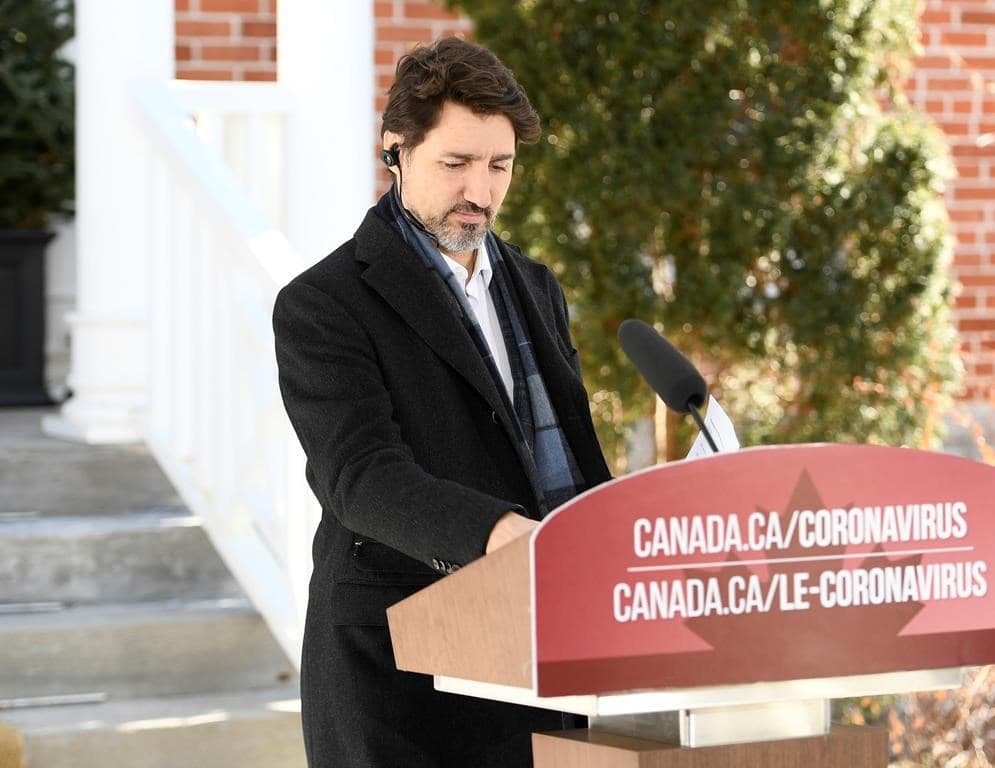
Prime Minister Justin Trudeau addressing the media outside Rideau Cottage/ The Canadian Press

Prime Minister Justin Trudeau says Canada is not at the point where the federal government needs to take emergency measures to force people to stay at home during the COVID-19 outbreak.

Trudeau says that provinces and local governments continue to take steps to restrict people's movements and the federal government stepping in is a last resort.

“There are many things that are being done and can be done at the local level, at the municipal level and at the provincial level.

The federal Emergencies Act is a significant step that can and should be taken when we've exhausted all other steps,'' Trudeau said at a news conference Sunday.

“We continue to work very closely with provinces, with other jurisdictions, to make sure that they are able to do the things that need to be done and we will continue to look at if it is necessary to move forward with the Emergencies Act.''

Nova Scotia became the latest province Sunday to declare a provincial state of emergency, joining several others including British Columbia, Alberta and Ontario.

The Northwest Territories closed its boundaries Saturday to travellers from other parts of Canada.

Gatherings in Nova Scotia are now to be no more than five people.

Premier Stephen McNeil said residents are blatantly ignoring the need for social distancing.

“Hundreds gathering on our beaches and in our parks, large groups of people congregating, young people playing street hockey, cars parked everywhere, people disregarding law enforcement,'' McNeil said.

“We are dealing with a deadly virus and this behaviour is unacceptable.''

Police in Nova Scotia are being given the power to enforce social distancing with $1,000 fines for individuals and $7,500 fines for businesses.

“Our provincial parks are closed. If you go there you are trespassing and your vehicles will be towed,'' McNeil said.

“You can get groceries, you can go to the pharmacy, but do not do it in packs. Identify a single family member who can do those errands.''

In Ottawa, federal Health Minister Patty Hajdu said people need to get the message about staying home or the federal government will step in.

“Asking them and recommending them and I am hoping that we don't have to get to ordering them,'' she said when asked what her message to Canadians is.

Nearly 1,400 cases of COVID-19 have been reported in Canada and 19 people have died.

Worldwide there have been more than 300,000 cases.

It was officially announced Sunday that the House of Commons will reconvene Tuesday to vote on measures to ease the financial burden the outbreak is posing on Canadians and their businesses.

The House will reconvene for four and a half hours to approve the emergency legislation put forward by the federal government.

There will be 32 MPs in the chamber which will be proportional to the representation of each party, said Government House Leader Pablo Rodriguez.

“We are all working together in the best interest of
Canadians,'' Rodriguez said.
Latest news

CanadaAug 26, 2026

41-Year-Old Punjabi Man Satwant Soni Sangha Killed in Downtown Toronto

A 41-year-old Punjabi man, Satwant “Sonny” Sangha, has been identified as the victim of a homicide in downtown Toronto. According to the Toronto Police Service, officers responded to a call about a sudden death at around 1:43 a.m. on August 21, 2026, in the area of McGill Street and Church Street. Police attended a residence where a male victim was found deceased.  An autopsy was later conducted, and signs of trauma were found on Sangha’s body. Following the autopsy findings, the death was classified as a homicide. Police have identified the victim as Satwant “Sonny” Sangha, 41, o
eby-urges-ottawa-to-consider-tougher-non-tariff-measures-in-u-s-trade-dispute
BCAug 26, 2026

Eby urges Ottawa to consider tougher non-tariff measures in U.S. trade dispute

B.C. Premier David Eby is urging Prime Minister Mark Carney’s federal government to consider measures beyond retaliatory tariffs in response to the ongoing trade dispute with the United States. Eby said Canada should consider stronger non-tariff measures and indicated B.C. could impose a surcharge on energy exports to the U.S. or restrict those exports if necessary. The premier also called on Ottawa to review its plan to purchase U.S.-made F-35 fighter jets. Eby argued that the current trade tensions should prompt a reassessment of the planned multibillion-dollar defence purchase. Eby also s
CanadaAug 25, 2026

Dingell Slams Trump Over Strained Canada-U.S. Relations, Urges Resumption of Talks

Michigan Democratic Congresswoman Debbie Dingell has strongly criticized President Donald Trump’s policies amid worsening relations between Canada and the United States, saying it is an extremely disappointing time for the country when the president appears more comfortable strengthening ties with dictators than talking to one of America’s closest friends and allies. Dingell said Canada and the United States share the world’s longest international border and are connected by generations of friendship, family ties, democratic values and the geography of the Great Lakes. Her comments come
wildfire-threat-eases-in-b-c-as-major-fires-drop-to-just-three
BCAug 25, 2026

Wildfire Threat Eases in B.C. as Major Fires Drop to Just Three

According to the B.C. Wildfire Service, the Brunswick Creek wildfire in the Fraser Canyon area is no longer considered a wildfire of note, after the threat posed by the blaze eased. The fire has now been removed from the province’s wildfire-of-note list, leaving just three major wildfires in B.C. The agency said, however, that firefighters are still working to fully contain the fire on the west side of the Fraser River. Meanwhile, the Ansley Creek wildfire on the east side of the river remains out of control and is one of the three remaining major wildfires in the province. The Bald Range wi
BCAug 25, 2026

Drug Toxicity Crisis in B.C.: 138 Deaths Reported in June 2026

Suspected unregulated drug toxicity claimed 138 lives in British Columbia in June 2026, according to preliminary data from the BC Coroners Service. That works out to approximately 4.6 deaths per day. During the first six months of 2026, people between the ages of 30 and 59 accounted for 68% of all drug-toxicity deaths in the province, while 75% of those who died were male. The Fraser and Vancouver Coastal health authorities recorded the highest numbers of unregulated drug deaths in 2026, with 206 and 200 deaths respectively. Together, they accounted for 52% of all such deaths in the province.

Related News