8.87°C Vancouver 8.87°C Vancouver
May 7, 2024 5:56 PM - The Associated Press
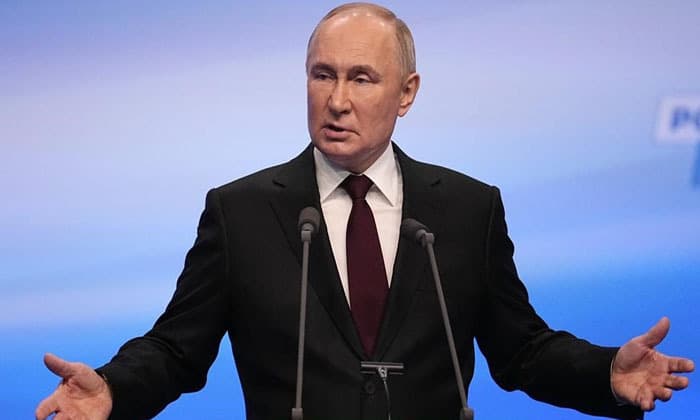
Vladimir Putin began his fifth term Tuesday as Russian leader at a glittering Kremlin inauguration, setting out on another six years in office after destroying his political opponents, launching a devastating war in Ukraine and concentrating all power in his hands.
Already in office for nearly a quarter-century and the longest-serving Kremlin leader since Josef Stalin, Putin’s new term doesn’t expire until 2030, when he will be constitutionally eligible to run again.
At the ceremony inside the gilded Grand Kremlin Palace, Putin placed his hand on the Russian Constitution and vowed to defend it as a crowd of hand-picked dignitaries looked on.
Since succeeding President Boris Yeltsin in the waning hours of 1999, Putin has transformed Russia from a country emerging from economic collapse to a pariah state that threatens global security. Following the 2022 invasion of Ukraine that has become Europe’s biggest conflict since World War II, Russia has been heavily sanctioned by the West and is turning to other regimes like China, Iran and North Korea for support.
Vladimir Putin begins his fifth term as Russian president in an opulent Kremlin inauguration Tuesday, after destroying his political opponents, launching a devastating war in Ukraine and consolidating all power in his hands.
Already in office for nearly a quarter-century and the longest-serving Kremlin leader since Josef Stalin, Putin’s new term doesn’t expire until 2030, when he is constitutionally eligible to run for another six years.
He has transformed Russia from a country emerging from economic collapse to a pariah state that threatens global security. Following the 2022 invasion of Ukraine that has become Europe’s biggest conflict since World War II, Russia has been heavily sanctioned by the West and is turning other regimes like China, Iran and North Korea for support.
The question now is what the 71-year-old Putin will do over the course of another six years, both at home and abroad.
Russian forces are gaining ground in Ukraine, deployingscorched-earth tacticsas Kyiv grapples withshortages of men and ammunition.Both sides are taking heavy casualties.
Ukraine has brought the battle to Russian soil through drone and missile attacks, especially in border regions. In a speech in February, Putin vowed to fulfillMoscow’s goals in Ukraine, and do what is needed to “defend our sovereignty and security of our citizens.”
Shortly after his orchestrated reelection in March, Putin suggested that a confrontation between NATO and Russia is possible, and he declared he wanted to carve out abuffer zonein Ukraine to protect his country from cross-border attacks.
At home, Putin's popularity is closely tied to improving living standards for ordinary Russians.
He began histerm in 2018by promising to get Russia into the top five global economies, vowing it should be “modern and dynamic.” Instead, Russia's economy has pivotedto a war footing, and authorities are spending record amounts on defense.
Analysts say now that Putin has secured another six years in power, the government could take the unpopular steps of raising taxes to fund the war and pressure more men to join the military.
At the start of a new term, the Russian government is routinely dissolved so that Putin can name a new prime minister and Cabinet.
One key area to watch is the Defense Ministry.
Last year, Defense Minister Sergei Shoigu came under pressure over his conduct of the war, with mercenary leaderYevgeny Prigozhinlaunching withering criticism against him for shortages of ammunition for his private contractors fighting in Ukraine. Prigozhin's brief uprising in June against the Defense Ministry represented the biggest threat to Putin's rule.
After Prigozhin was killed two months later in a mysterious plane crash, Shoigu appeared to have survived the infighting. But last month, his protege, Deputy Defense Minister Timur Ivanov, was detained on charges of bribery amid reports of rampant corruption.
Some analysts have suggested Shoigu could become a victim of the government reshuffle but that would be a bold move as the war is still raging in Ukraine.
In the years following the invasion,authorities have cracked downon any form of dissent with a ferocity not seen since Soviet times. There is no sign that this repression will ease in Putin's new term.
His greatest political foe, opposition leaderAlexei Navalny,died in an Arctic penal colony in February. Other prominent critics have either been imprisoned or have fled the country, and even some of hisopponents abroad fear for their security.
Laws have been enacted that threaten long prison terms for anyone who discredits the military. The Kremlin also targets independent media, rights groups, LGBTQ+ activists and others who don't hew to what Putin has emphasized as Russia's “traditional family values.”