9.17°C Vancouver 9.17°C Vancouver
Apr 24, 2024 4:13 PM - The Associated Press
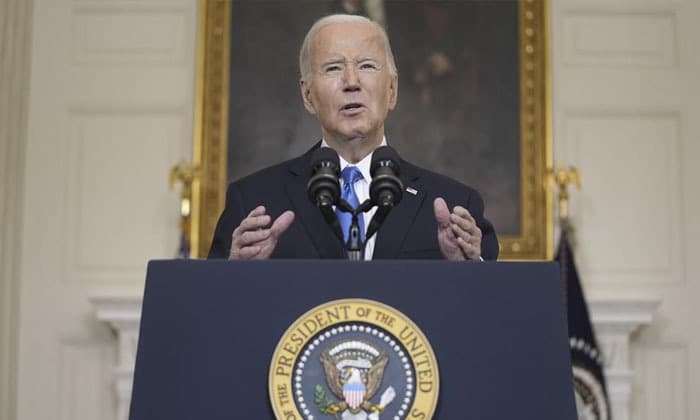
President Joe Bidensigned into law into law Thursdaya $95 billion war aid measurethat includes aid for Ukraine, Israel and Taiwan that also includes a provision that would force social media site TikTok to be sold or be banned in U.S.
The announcement marks an end to long, painful battle with Republicans in Congress over urgently needed assistance for Ukraine.
“We rose to the moment. we came together. and we got it done," Biden said at White House event to announce the signing. "Now we need to move fast, and we are,”
But significant damage has been done to the Biden administration’s effort to help Ukraine repel Russia’s brutal invasion during the funding impasse that dates back to August, when the Democratic president made his first emergency spending request for Ukraine aid. Even with a burst of new weapons and ammunition, it is unlikely Ukraine will immediately recover after months of setbacks.
Biden said the transfer of an initial aid package ofmilitary assistancewill begin in a matter of hours the first tranche from about $61 billion allocated for Ukraine, according to U.S. officials. It is expected to include air defense capabilities, artillery rounds, armored vehicles and other weapons to shore up Ukrainian forces who have seen morale sink as Russian President Vladimir Putin has racked up win after win.
But longer term, it remains uncertain if Ukraine after months of losses in Eastern Ukraine and sustaining massive damage to its infrastructure can make enough progress to sustain American political support before burning through the latest influx of money.
“It’s not going in the Ukrainians' favor in the Donbas, certainly not elsewhere in the country,” said White House national security spokesman John Kirby, referring to the eastern industrial heartland where Ukraine has suffered setbacks. “Mr. Putin thinks he can play for time. So we’ve got to try to make up some of that time.”
Russia now appears focused on Kharkiv, Ukraine's second largest city. Russian forces have exploited airdefense shortages in the city,pummeling the region’s energy infrastructure, and looking to shape conditionsfor a potential summer offensiveto seize the city.
House Speaker Mike Johnson delayed a vote on the supplemental aid package for months as members of his party's far right wing, including Reps. Marjorie Taylor Greene of Georgia and Thomas Massie of Kentucky, threatened to move to oust him if he allowed a vote to send more assistance to Ukraine. Those threats persist.
Senate Minority Leader Mitch McConnell suggested his fellow Republicans' holding up the funding could have a lasting impact on Ukraine's hopes of winning the war.
“Make no mistake: Delay in providing Ukraine the weapons to defend itself has strained the prospects of defeating Russian aggression,” McConnell said Tuesday. "Dithering and hesitation have compounded the challenges we face.”
Former President Donald Trump, the presumptive 2024 presidential GOP nominee, has complained that European allies have not done enough for Ukraine. While he stopped short of endorsing the supplemental funding package, his tone has shifted in recent days, acknowledging that Ukraine's survival is important to the United States.
Indeed, many European leaders have long been nervous that a second Trump presidency would mean decreased U.S. support for Ukraine and for the NATO military alliance. The European anxiety was heightened in February when Trump in a campaign speech warnedNATO alliesthat he “would encourage” Russia“to do whatever the hell they want”to countries that don't meet defense spending goals if he returns to the White House.
It was a key moment in the debate over Ukraine spending. NATO Secretary-General Jens Stoltenberg quickly called out Trump for putting“American and European soldiers at increased risk.”Biden days later called Trump's comments"dangerous" and “un-American”and accused Trump of playing into Putin's hands.
But in reality, the White House maneuvering to win additional funding for Ukraine started months earlier.
Biden, the day after returning from a whirlwind trip to Tel Aviv following Hamas militants' stunning Oct. 7 attack on Israel, used a rare prime time address to make his pitch for the supplemental funding.
At the time, the House was in chaos because the Republican majority had beenunable to select a speakerto replace Rep. Kevin McCarthy, who had been ousted more than two weeks earlier. McCarthy’s reckoning with the GOP's far right came after he agreed earlier in the year to allow federal spending levels that many in his right flank disagreed with and wanted undone.
Far-right Republicans have also adamantly opposed sending more money for Ukraine, with the war appearing to have no end in sight. Biden in August requested more than $20 billion to keep aid flowing into Ukraine, but the money was stripped out ofa must-pass spending billeven as Ukrainian President Volodymyr Zelenskyy traveled to Washington to makea personal pleafor continued U.S. backing.
By late October, Republicans finally settled on Johnson, a low-profile Louisiana Republican whose thinking on Ukraine was opaque, to serve as the next speaker. Biden during his congratulatory call with Johnson urged him to quickly pass Ukraine aid and began a months-long, largely behind-the-scenes effort to bring the matter to a vote.
In private conversations with Johnson, Biden and White House officials leaned into the stakes for Europe if Ukraine were to fall to Russia. Five days after Johnson was formally elected speaker, national security adviser Jake Sullivan outlined to him the administration's strategy on Ukraine and assured him that accountability measures were in place in Ukraine to track where the aid was going an effort to address a common complaint from conservatives.
On explicit orders from Biden himself, White House officials also avoided directly attacking Johnson over the stalled aid a directive the president repeatedly instilled in his senior staff.
For his part, Johnson came off to White House officials as direct and an honest actor throughout the negotiations, according to a senior administration official. Biden had success finding common ground with Republicans earlier in his term to win the passage of a$1 trillion infrastructure deal,legislation to boost the U.S. semiconductor industry,and an expansion of federal health care services for veterans exposed to toxic smoke from burn pits. And he knew there was plenty of Republican support for further Ukraine funding.
At frustrating moments during the negotiations, Biden urged his aides to “just keep talking, keep working,” according to the official, who requested anonymity to discuss internal discussions.
So they did. In a daily meeting convened by White House chief of staff Jeff Zients, the president's top aides seated around a big oval table in Zients' office would brainstorm possible ways to better make the case about Ukraine’s dire situation in the absence of aid.
Steve Ricchetti, counselor to the president, and legislative affairs director Shuwanza Goff were in regular contact with Johnson. Goff and Johnson’s senior staff also spoke frequently as a deal came into focus.
The White House also sought to accommodate Johnson and his various asks. For instance, administration officials at the speaker's request briefed Reps. Chip Roy, R-Texas, and Ralph Norman, R-S.C. two conservatives who were persistent antagonists of Johnson.
All the while, senior Biden officials frequently updated McConnell as well as key Republican committee leaders, including Reps. Michael McCaul and Mike Turner.
Senate Majority Leader Chuck Schumer, D-N.Y., said Biden's instincts to resist pressuring Johnson proved correct.
“Joe Biden has a very good sense of when to heavily intervene and when to try to shape things,” Schumer said.
In public, the administration deployed a strategy of downgrading intelligence that demonstrated Russia's efforts to tighten its ties with U.S. adversaries China, North Korea and Iran to fortify Moscow's defense industrial complex and get around U.S. and European sanctions.
For example, U.S. officials this month laid out intelligence findings that showedChina has surged salesto Russia of machine tools, microelectronics and other technology that Moscow in turn is using to produce missiles, tanks, aircraft and other weaponry. Earlier, the White House publicized intelligence that Russia has acquired ballistic missiles fromNorth Koreaand has acquired attack drones fromIran.
The $61 billion can help triage Ukrainian forces, but Kyiv will need much more for a fight that could last years, military experts say.
Realistic goals for the months ahead for Ukraine and its allies include avoiding the loss of major cities, slowing Russia's momentum and getting additional weaponry to Kyiv that could help them go on the offensive in 2025, said Bradley Bowman, a defense strategy and policy analyst at the Foundation for the Defense of Democracies in Washington.
“In our microwave culture, we tend to want immediate results,” Bowman said. “And sometimes things are just hard and you can’t get immediate results. I think Ukrainian success is not guaranteed, but Russian success is if we stop supporting Ukraine."