16.96°C Vancouver

Nov 26, 2021 10:34 PM - The Canadian Press
Variant prompts Canada to bring in ban on travellers from southern Africa

Share On
variant-prompts-canada-to-bring-in-ban-on-travellers-from-southern-africa
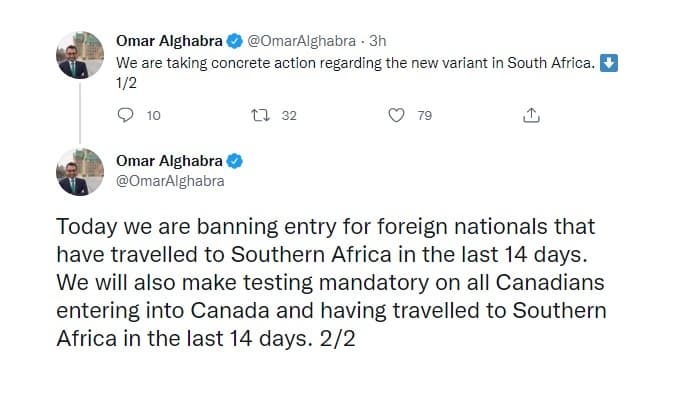
Canada has banned visitors from southern Africa after the discovery of a new variant of concern in the region. (Photo - Omar Alghabra/Twitter)

Canada has banned visitors from southern Africa after the discovery of a new variant of concern in the region.

The new variant, deemed Omicron, first emerged in South Africa and coincided with a steep rise in the number of COVID-19 cases in that region in recent weeks, according to the World Health Organization.

The ban will apply to foreign nationals who transited through a list of seven countries in the last 14 days, including South Africa, Mozambique, Botswana, Zimbabwe, Lesotho, Namibia and eSwatini.

Those already in Canada who recently travelled through the region will need to quarantine, and be tested for COVID-19.

Global Affairs is also issuing an advisory to discourage non-essential travel to South Africa and neighbouring countries.

Canadian citizens and permanent residents arriving home from the region must get a COVID-19 test before they return, and will need to quarantine at a designated hotel until their entry test proves negative.

After that they will be able to isolate at home until they test negative ten days after arrival.

Currently there are no direct flights from southern Africa to Canada.

``We know very little about this variant right now,'' Canada's chief public health officer, Dr. Theresa Tam, said at a briefing Friday.

The mutations that have been detected show the potential for greater transmissibility, she said, and she won't be surprised to see cases crop up in Canada.

``This variant has a large number of mutations, some of which are concerning,'' the WHO wrote in a statement Friday.

``Preliminary evidence suggests an increased risk of reinfection with this variant, as compared to other (variants of concern.)''

Opposition parties and provincial premiers have called for strict border measures to prevent cases of the potentially dangerous new variant from being imported into Canada.

Conservative Leader Erin O'Toole had called on the Canadian government to issue travel advisories, banning non-essential travel to and from the region earlier Friday morning.

``With reports of the spread of a new COVID-19 variant, we have a small window of opportunity to act, and we must move now,'' O'Toole said in a statement.

The party was critical when the government delayed closing Canada's borders at the outset of the pandemic in 2020.

The premiers for Alberta, Ontario and Quebec also called for all travellers originating from those countries to be banned from Canada until more is known about the variant.

Researchers are already working to learn more about the effects of this new variant, according to WHO's COVID-19 technical lead Dr. Maria Van Kerkhove.

``Researchers are getting together to understand where these mutations are, and what that potentially may mean for our diagnostics or therapeutics in our vaccines,'' she said at a briefing Thursday.


Latest news

CanadaAug 26, 2026

41-Year-Old Punjabi Man Satwant Soni Sangha Killed in Downtown Toronto

A 41-year-old Punjabi man, Satwant “Sonny” Sangha, has been identified as the victim of a homicide in downtown Toronto. According to the Toronto Police Service, officers responded to a call about a sudden death at around 1:43 a.m. on August 21, 2026, in the area of McGill Street and Church Street. Police attended a residence where a male victim was found deceased.  An autopsy was later conducted, and signs of trauma were found on Sangha’s body. Following the autopsy findings, the death was classified as a homicide. Police have identified the victim as Satwant “Sonny” Sangha, 41, o
eby-urges-ottawa-to-consider-tougher-non-tariff-measures-in-u-s-trade-dispute
BCAug 26, 2026

Eby urges Ottawa to consider tougher non-tariff measures in U.S. trade dispute

B.C. Premier David Eby is urging Prime Minister Mark Carney’s federal government to consider measures beyond retaliatory tariffs in response to the ongoing trade dispute with the United States. Eby said Canada should consider stronger non-tariff measures and indicated B.C. could impose a surcharge on energy exports to the U.S. or restrict those exports if necessary. The premier also called on Ottawa to review its plan to purchase U.S.-made F-35 fighter jets. Eby argued that the current trade tensions should prompt a reassessment of the planned multibillion-dollar defence purchase. Eby also s
CanadaAug 25, 2026

Dingell Slams Trump Over Strained Canada-U.S. Relations, Urges Resumption of Talks

Michigan Democratic Congresswoman Debbie Dingell has strongly criticized President Donald Trump’s policies amid worsening relations between Canada and the United States, saying it is an extremely disappointing time for the country when the president appears more comfortable strengthening ties with dictators than talking to one of America’s closest friends and allies. Dingell said Canada and the United States share the world’s longest international border and are connected by generations of friendship, family ties, democratic values and the geography of the Great Lakes. Her comments come
wildfire-threat-eases-in-b-c-as-major-fires-drop-to-just-three
BCAug 25, 2026

Wildfire Threat Eases in B.C. as Major Fires Drop to Just Three

According to the B.C. Wildfire Service, the Brunswick Creek wildfire in the Fraser Canyon area is no longer considered a wildfire of note, after the threat posed by the blaze eased. The fire has now been removed from the province’s wildfire-of-note list, leaving just three major wildfires in B.C. The agency said, however, that firefighters are still working to fully contain the fire on the west side of the Fraser River. Meanwhile, the Ansley Creek wildfire on the east side of the river remains out of control and is one of the three remaining major wildfires in the province. The Bald Range wi
BCAug 25, 2026

Drug Toxicity Crisis in B.C.: 138 Deaths Reported in June 2026

Suspected unregulated drug toxicity claimed 138 lives in British Columbia in June 2026, according to preliminary data from the BC Coroners Service. That works out to approximately 4.6 deaths per day. During the first six months of 2026, people between the ages of 30 and 59 accounted for 68% of all drug-toxicity deaths in the province, while 75% of those who died were male. The Fraser and Vancouver Coastal health authorities recorded the highest numbers of unregulated drug deaths in 2026, with 206 and 200 deaths respectively. Together, they accounted for 52% of all such deaths in the province.

Related News