11.69°C Vancouver 11.69°C Vancouver
Jun 13, 2024 6:26 PM - The Canadian Press
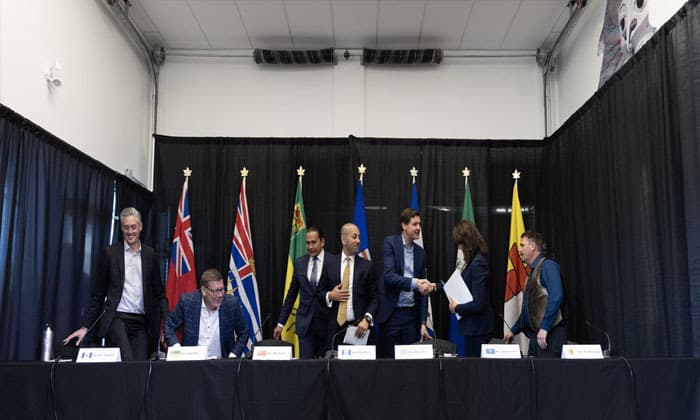
Premier David Eby is expanding his criticism of what he says is an unfair share of federal funding being given to Western Canada.
Eby says Ottawa's "special treatment for Quebec and Ontario" eventually gets "to be too much" and it's "disingenuous" for federal Immigration Minister Marc Miller to suggest that B.C.'s concerns are simply about asylum seekers.
Eby and Miller have traded comments this week since the premier suggested at the Western Premiers' Conference on Monday that Ottawa was "showering" Ontario and Quebec with money, after offering Quebec a $750 million deal to help with immigration concerns.
Miller responded that British Columbia needs to step up and take in more asylum seekers who come to Canada.
Political-watchers say the premier's tough talk is likely linked to the upcoming provincial election and a desire to be seen as separate from the unpopular federal Liberals.
Eby said in a statement Wednesday that it was "disingenuous to say this is about asylum seekers."
"Ottawa is spending billions to build car factories in Ontario and Quebec, but has so far refused to put in their fair share to replace the Massey Crossing," Eby said.
The province is in the process of replacing the George Massey Tunnel under the Fraser River between Richmond and Delta by 2030, with an estimated price tag of $4.15 billion. Provincial officials have said they hope Ottawa will contribute to the bill, but no specific figure has been set.
"I think people in the west are used to the special treatment for Quebec and Ontario, but eventually it gets to be too much," Eby's statement said.
Honda announced last month that it would build an electric vehicle battery plant next to its assembly plant in Alliston, Ont., as part of a $15-billion project to create a supply chain in the province.
The plan comes with up to $5 billion in public funds.
Eby said population growth is needed but it also puts considerable strain on infrastructure, housing and economic development opportunities. "No matter how you look at it, in exact dollars, per capita, or as a ratio of our GDP, western provinces get less from the federal government," he said. "All I ask is that British Columbians get their fair share from Ottawa to support our rapidly growing population so that everyone can build a good life here."
Eby said last year the number of asylum seekers arriving in B.C. doubled, and that is on track to almost double again this year.
His office points to data published by Immigration, Refugees and Citizenship Canada that shows 3,890 asylum claimants were processed for B.C. in 2022, increasing to 7,685 in 2023.
The same numbers for Quebec show a jump from 58,800 in 2022 to 65,425 in 2023.
In Ottawa Wednesday, Miller reiterated that the money for Quebec is for asylum seekers and that Ontario and Quebec have been taking on a disproportionate portion of that population.
He said discussions about B.C.'s portion of federal funding overall would involve a lot more ministers than him alone.
Miller called concerns about the Quebec deal "certainly surprising from a progressive premier."
"But again, there's work to be done around the table. We've had a great working relationship with (Eby)," he said.
"We absolutely need him and his team at the table for the next stage of things, which is making sure we're doing a fair apportionment of asylum seekers across Canada where Ontario and Quebec has been taking on a disproportionate portion of asylum seekers in the federation."
Gerald Baier, an associate professor of political science at the University of British Columbia, said it's common for provincial politicians, particularly in the lead-up to an election, to defer some responsibility for difficult policy issues onto the federal government.
"The federal Liberals aren't particularly popular right now and this is a way of not necessarily endorsing the federal Conservatives, because they have a B.C. counterpart now, but also saying that it's not entirely our fault if you don't like the policy here in B.C.," Baier said.
Stewart Prest, a political science lecturer at the University of British Columbia, said calls for more federal money following premiers' conferences are a "time honoured Canadian tradition."
He said with the potential for a tough election in the fall, and the federal Liberals not being particularly popular, there's value for Eby in looking tough.
"(That's) both to show that he is an assertive leader and pushing for the best deal for British Columbia, but also to create a little daylight between himself and the federal government," he said.